Diamond Carat Guide
Learn everything about diamond carat weight - from how it affects price and appearance to choosing the perfect size for your style and budget.
What is Diamond Carat Weight?
Carat, abbreviated as "ct", is technically a unit of weight rather than size. One carat equals 0.2 grams. However, in everyday language, carat is commonly used to refer to a diamond's size. When someone says they have a 1ct diamond, most people picture how large it looks on the finger rather than how much it weighs on a scale.
It is important to understand that two diamonds of the same carat weight can appear quite different in size. This is because a diamond's visible dimensions depend on how it has been cut and on its length to width ratio. A well proportioned diamond will spread its weight across the top surface, making it look larger to the eye, while a deeper cut diamond may carry more of its weight hidden beneath the setting, appearing smaller despite weighing exactly the same.
So while carat gives you a reliable indication of a diamond's weight, the shape, cut quality and proportions ultimately determine how large or small it will look when worn. That is why it is always worth considering cut alongside carat when choosing your diamond.
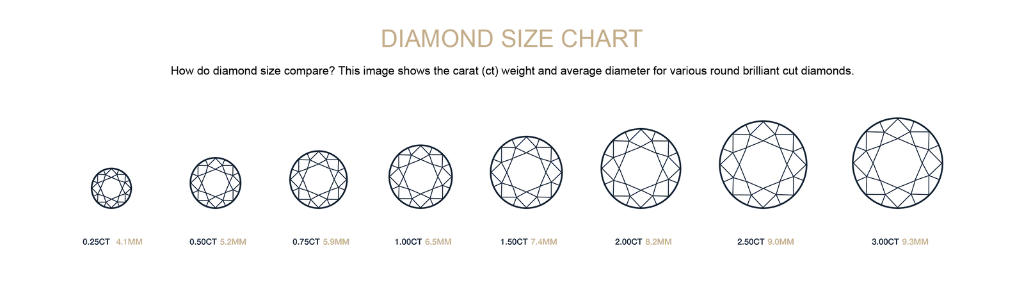
How Does Carat Weight Affect Diamond Size?
While carat is a measure of weight, what most people really want to know is how big the diamond will look. Generally speaking, the higher the carat weight, the larger the diamond will be, and carat can be used as a reliable starting point to get a rough estimate of how big a diamond will appear. However, carat weight alone does not tell the full story. Two diamonds that weigh exactly the same can look noticeably different in size depending on how they have been cut and what shape they are.
A diamond's visible size is largely determined by its surface area, which is the flat top of the stone that you see when it is set in a ring. A well proportioned diamond spreads its weight evenly across this surface, giving it a larger face up appearance. On the other hand, a diamond that has been cut too deep will carry much of its weight in the base, making it appear smaller from above even though it weighs the same on a scale.
Diamond shape also plays a significant role. Elongated shapes such as oval, marquise and pear tend to have a larger surface area than round diamonds of the same carat weight, which means they can appear noticeably bigger on the finger. For example, a 1 carat oval diamond will typically look larger than a 1 carat round diamond simply because of the way the weight is distributed.
Your ring setting can further enhance the perceived size of your diamond. Halo settings, where a ring of smaller diamonds surrounds the centre stone, can make the diamond appear up to half a carat larger. Similarly, a thin, delicate band draws more attention to the centre stone and makes it stand out more prominently. So when choosing your carat weight, it is worth thinking about the overall design of the ring as well.
How Diamond Carat Affects Price
The price of diamonds increases exponentially with carat weight, meaning price points can jump by large increments as the carat goes up. A 2 carat diamond, for example, costs far more than twice the price of a 1 carat diamond of similar quality. This is because larger diamonds are much rarer, so the value of one large stone will always be far greater than two smaller diamonds that amount to the same total carat weight.
Certain carat weights such as 0.50ct, 1.00ct, 1.50ct and 2.00ct are especially popular, creating what are known as "magic numbers" where prices jump significantly. You can often find better value by choosing a diamond just below these popular weights, as the visual difference is minimal but the savings can be substantial.
Popular Carat Weights & Pricing
Here are the most popular carat weights and their approximate prices for lab-grown diamonds (Excellent Cut, VS1 Clarity, F Colour).
| Carat | Price | Category | Description |
|---|---|---|---|
| 0.50ct | €865 - €1,040 | Budget-friendly choice | Perfect for delicate, elegant designs or budget-conscious buyers |
| 1.00ct | €1,785 - €2,295 | Most popular | The most popular choice. Perfect balance of size and value |
| 1.50ct | €3,050 - €3,460 | Luxury choice | Impressive size with excellent presence on the hand |
| 2.00ct | €4,385 - €5,000 | Premium selection | Statement piece with remarkable brilliance and fire |
| 2.50ct | €4,800 | Ultra-luxury | Exceptionally rare and impressive, for special occasions |
* Prices are accurate at the time of writing and are subject to market fluctuations.
* These are the prices of the diamonds only, without the setting of the jewel.
Tips for Choosing the Right Carat
Carat weight has the biggest impact on price, so it is wise to set your budget first and work backwards to find the best carat weight within that range. It is worth noting that a 0.90ct diamond can look nearly identical to a 1.00ct but cost significantly less, making it a smart alternative if you want to maximise value without compromising on appearance.
Your lifestyle should also play a role in your decision. Very large diamonds may not be practical for active, hands-on lifestyles, and for most people a diamond between 1.00ct and 1.50ct offers the best balance of visual presence and everyday wearability.
Finger size is another factor worth considering. Smaller hands naturally make a diamond appear larger, while larger hands can make the same stone look more modest. If possible, try different sizes in person or ask for reference images showing how various carat weights look when worn.
Finally, do not underestimate the impact of the setting. The right design can make a diamond appear significantly larger and more brilliant. Halo settings, for example, can make a centre stone look up to half a carat bigger, while a thin, delicate band draws the eye to the diamond and enhances its overall presence.
Frequently Asked Questions
The most popular carat weight for engagement rings is 1.00ct, as it offers an ideal balance between visual presence and value. However, many couples are increasingly choosing diamonds between 1.00ct and 1.50ct for a slightly more impressive look without a dramatic jump in price.
Not necessarily. Carat measures weight, not size. Two diamonds of the same carat weight can appear different in size depending on their cut quality and shape. A well-cut diamond spreads its weight across the top surface, appearing larger, while a deeper cut diamond may carry weight hidden beneath the setting.
Prices increase significantly at popular thresholds like 0.50ct, 1.00ct, 1.50ct and 2.00ct because demand is highest at these round numbers. Choosing a diamond just below these thresholds, such as 0.90ct instead of 1.00ct, can offer substantial savings with minimal visual difference.
Yes, lab-grown diamonds are available across the full range of carat weights, from small accent stones to impressive centre stones of 3 carats and above. Because they are grown in controlled environments, they tend to be more readily available at larger sizes compared to natural diamonds.
There are several effective strategies. Choosing an elongated shape such as oval or marquise creates a larger visual footprint. Opting for a halo setting surrounds the centre stone with smaller diamonds, making it appear up to half a carat larger. A thin, delicate band also draws attention to the diamond and enhances its perceived size.
Our Expert Recommendation
For most people, we recommend focusing on cut quality first, then choosing the largest carat weight within your budget. A well-cut 0.90ct diamond will look more brilliant than a poorly cut 1.10ct diamond and cost significantly less.